How the Scottish ranking was built
Buy to let yields in Scotland, measured gross from live listings, sit at a median of 8.1% across the districts we analysed. G1 leads the table at 9.2%. We ranked 20 postcode districts in Scotland to show where asking rents are highest relative to asking prices.
The method is simple. For each district we took the annual rent on live rental listings and set it against asking prices on live sale listings, then expressed the rent as a share of the price. That is a gross yield. It ignores costs, voids, finance and tax, and it works from asking figures rather than agreed rents or completed sale prices.
Each district needed enough listings to give a stable reading. The table further down shows how many sat behind each figure. Where the count is small, a handful of odd properties can move the result, so thinner districts deserve more caution than busy ones.
The districts at the top of the table
G1 sits first on 9.2%. Close behind is PA15 on 9.1%. The gap at the very top is narrow. G31 follows on 8.7%, level with AB11 on 8.7%.
Below them, AB25 records 8.6% and G52 records 8.6%. G2 comes next on 8.5%, then KA1 and G11, both on 8.2%.
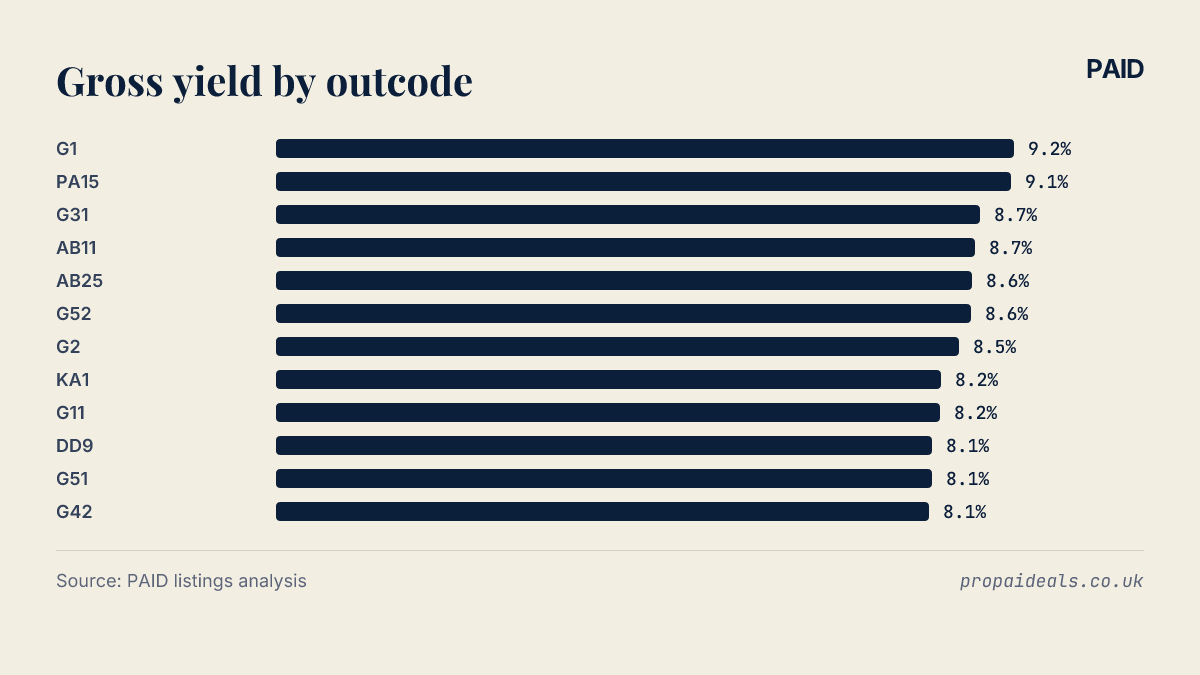
Glasgow districts make up much of the table, with Aberdeen, Dundee, Paisley and Kilmarnock districts also present. That tells you where the ratio of rent to price is highest. It does not tell you why, and nothing in these figures explains the cause.
The typical buy to let yield in Scotland and the spread around it
For typical rental yields in Scotland across these districts, the median of 8.1% is a better guide than the top figure. A whole cluster sits right on it: DD9, G51, G42, G5, PA3, G32 and AB10 all record 8.1%.
The spread is tight. The lowest district in the ranking, DD1, still shows 7.8%, against 9.2% at the top. AB24 on 8.0%, and G13 and G44 on 7.9%, fill the lower end.
| Rank | Outcode | Area | Gross yield | Listings |
|---|---|---|---|---|
| 1 | G1 | Scotland | 9.2% | 128 |
| 2 | PA15 | Scotland | 9.1% | 51 |
| 3 | G31 | Scotland | 8.7% | 74 |
| 4 | AB11 | Scotland | 8.7% | 105 |
| 5 | AB25 | Scotland | 8.6% | 64 |
| 6 | G52 | Scotland | 8.6% | 38 |
| 7 | G2 | Scotland | 8.5% | 97 |
| 8 | KA1 | Scotland | 8.2% | 158 |
| 9 | G11 | Scotland | 8.2% | 64 |
| 10 | DD9 | Scotland | 8.1% | 82 |
| 11 | G51 | Scotland | 8.1% | 44 |
| 12 | G42 | Scotland | 8.1% | 59 |
| 13 | G5 | Scotland | 8.1% | 88 |
| 14 | PA3 | Scotland | 8.1% | 30 |
| 15 | G32 | Scotland | 8.1% | 70 |
| 16 | AB10 | Scotland | 8.1% | 76 |
| 17 | AB24 | Scotland | 8.0% | 81 |
| 18 | G13 | Scotland | 7.9% | 60 |
| 19 | G44 | Scotland | 7.9% | 47 |
| 20 | DD1 | Scotland | 7.8% | 91 |
Scottish letting rules that affect the return
Gross yield is the starting point. What a landlord keeps is smaller, and in Scotland the letting framework shapes some of the costs and much of the flexibility in between.
Landlords must register with the local council for the area where the property sits before letting it. Registration carries a fee and has to be renewed, and letting without it is an offence. It is a modest cost. It still applies to every let.
New lets use the private residential tenancy. It has no fixed end date, and a landlord can only end it on specific grounds set out in law. For anyone used to fixed term tenancies elsewhere in the UK, that changes how exit plans and refurbishment timing work, so read the current official guidance before relying on any assumption.
Then come the usual running costs: letting or management fees, repairs, insurance, safety checks and the weeks between tenants. Voids are the one people underestimate. A high gross figure narrows quickly once all of this is counted, and by how much differs from one property to the next.
Using the ranking to plan a Scottish purchase
Treat the ranking as a shortlist for closer research. It points to the best postcodes for landlords in Scotland on one measure only, gross yield from asking figures.
From there, the useful work is checking achieved rents against asking rents in the district, looking at the type of property behind the figure and estimating net yield with realistic costs and voids. Registration and the private residential tenancy belong in that net calculation from the start.
To see what is currently listed, you can browse investment properties. For more on working out net returns and what the Scottish rules involve in practice, see our guides.

